Materials and Comparisons
What Is the Best Fence Material for Michigan Weather?
Michigan's climate places specific demands on fence materials. Freeze-thaw cycling, seasonal moisture, snow load, UV exposure, and wind each stress fencing differently depending on material, installation quality, and maintenance. This guide compares wood, vinyl, aluminum, and chain link across the conditions that matter most in West Michigan, so you can make a more informed decision before requesting contractor quotes.
Quick Answer
For Michigan weather specifically, the primary concerns are freeze-thaw movement at the post-footing level, moisture exposure on panels and posts, wind load on solid fence panels, and UV degradation over time. Every material shares the frost-line requirement: posts must be set below the approximately 42-inch frost depth in Kent County to prevent winter heave. [2] Above the frost line, the materials diverge significantly in how they respond to moisture, temperature change, corrosion, and impact.
Vinyl and aluminum require less annual maintenance than wood in Michigan's wet climate. Wood requires consistent staining and sealing to resist moisture-driven decay. [1] Chain link galvanized for corrosion resistance performs well structurally but provides no privacy. The comparison table below captures the key differences across ten criteria relevant to Michigan conditions.
Michigan Climate Factors
West Michigan's climate creates specific fence performance challenges that differ from warmer or drier regions. Understanding these factors helps clarify why material choice and installation practice matter more here than in a milder climate.
Freeze-thaw cycling. West Michigan typically experiences repeated freeze-thaw cycles throughout winter and early spring. Water in the soil freezes and expands, exerting upward pressure on anything embedded in the frost zone. This process is called frost heave and is the primary structural failure mechanism for fence posts in Michigan. [2] The frost depth in Kent County reaches approximately 42 inches below grade, and posts must be set below that depth.
Moisture exposure. Michigan's high annual precipitation and significant snowfall create sustained moisture exposure at the fence base and along panel surfaces. Materials that absorb moisture or corrode under extended wet contact degrade faster than those that resist it. [1]
Temperature range. The swing between West Michigan's summer highs and winter lows is significant. Fence materials expand in heat and contract in cold. Vinyl, in particular, has a higher thermal expansion coefficient than metal or wood, which means larger dimensional changes across the year.
UV exposure. Summer UV levels in West Michigan are meaningful, particularly for south-facing fence sections. UV degrades surface coatings on wood and pigments in vinyl over time. Aluminum's powder-coat finish is also subject to UV degradation at a slower rate.
Snow and ice load. Heavy snow accumulation on horizontal fence surfaces and ice-laden branches falling on fence panels add structural load. Solid wood and vinyl privacy panels catch more snow than open-style aluminum or chain link.
Material Comparison Table
Grand Rapids Fence comparison based on cited material characteristics, maintenance requirements, repairability, and Michigan climate considerations. All claims cited below. Data reviewed August 2026.
| Criteria | Wood | Vinyl | Aluminum | Chain Link |
|---|---|---|---|---|
| Moisture resistance | Low to moderate; susceptible to rot without maintenance [1] | High; does not absorb water or rot [3] | High; does not rust [5] | Moderate; galvanized coating resists rust; bare steel rusts |
| Freeze-thaw at posts | Post must be below frost line; post rot at ground line accelerates if wet [2] | Post must be below frost line; vinyl panels more brittle in cold [3] | Post must be below frost line; aluminum panels unaffected by cold | Post must be below frost line; mesh unaffected by cold |
| Corrosion | Wood decays rather than corrodes; hardware can rust [1] | No corrosion; hardware should be stainless or galvanized | Does not rust or corrode [5] | Galvanized resists rust; vinyl-coated adds further protection |
| Impact resistance | Moderate; individual boards can crack, dent, or break | Low in cold temps; premium-grade vinyl resists better than economy [3] | Low to moderate; aluminum dents under significant impact | High; mesh deforms without breaking; easier to repair |
| Annual maintenance | High; staining or sealing every 3 to 5 years required [1] | Low; periodic washing; no painting or sealing [3] | Very low; inspect finish; touch up if powder coat damaged [5] | Low; inspect for rust at cut ends and fittings |
| Repairability | High; individual boards, rails, posts replaced independently | Moderate; section replacement requires matching profile [4] | Moderate; panel sections replaceable; matching may be needed | High; mesh sections and fittings repaired individually [4] |
| Privacy | Full privacy with solid board styles | Full privacy with solid panel styles [3] | Open style only; no privacy without add-ons | Open; privacy slats available at added cost |
| Wind exposure | Solid panels catch wind load; heavier than vinyl | Solid panels catch wind load; lighter panels flex under wind | Open style allows wind through; less wind load on structure [5] | Open mesh allows wind through; very low wind load |
| Snow contact | Solid panels accumulate snow; moisture from snow contact accelerates decay if unmaintained [1] | Solid panels accumulate snow; no moisture damage from snow contact | Open style sheds snow; no snow accumulation on panels | Open mesh sheds snow; no accumulation concern |
| Installation sensitivity | Moderate; wood can be cut and adjusted on site | High; posts and panels must be aligned correctly; thermal expansion must be accommodated [3] | High; panel connections and post alignment are manufacturer-specific | Moderate; mesh can be adjusted for grade changes |
Wood Fencing in Michigan
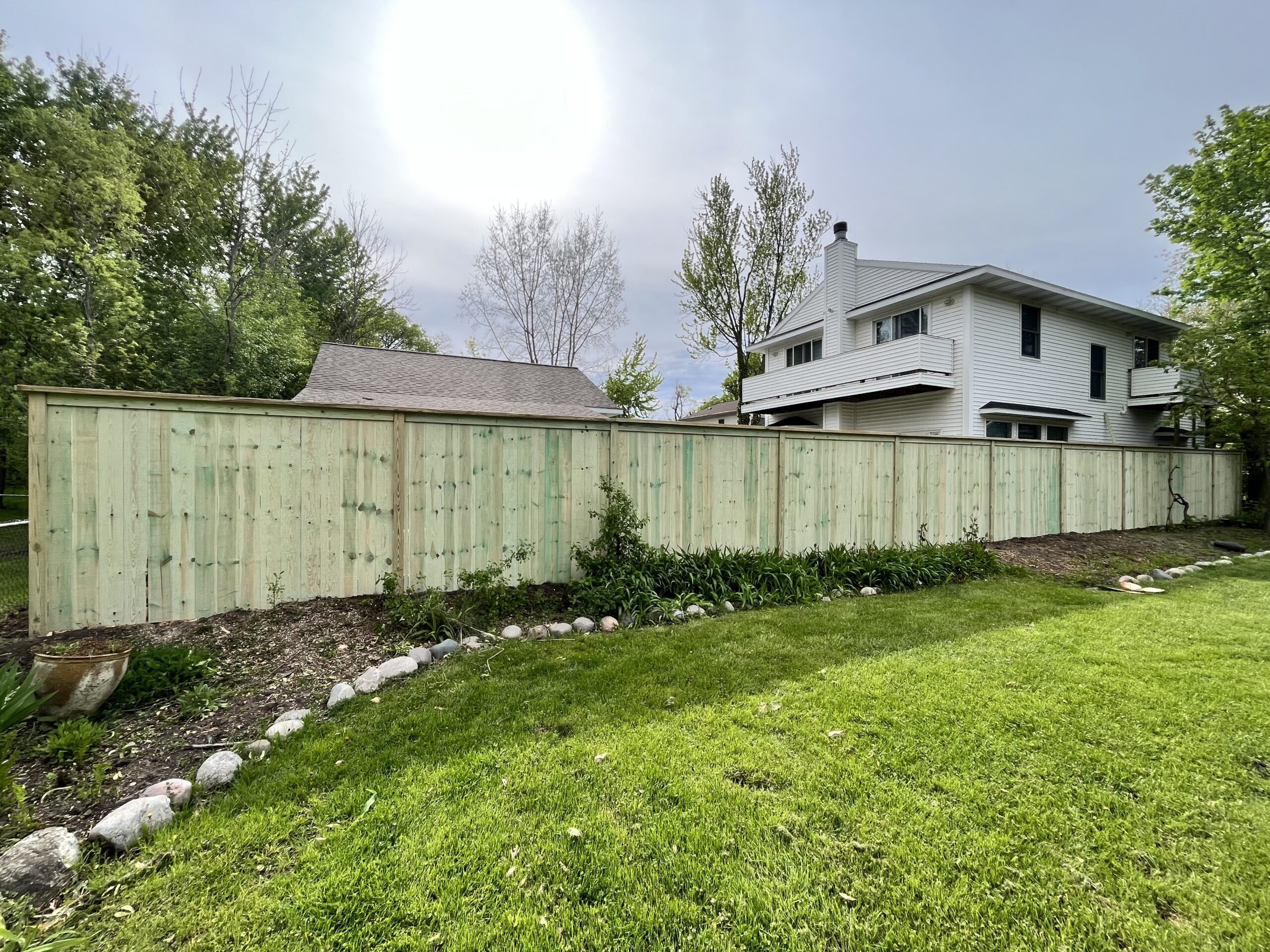
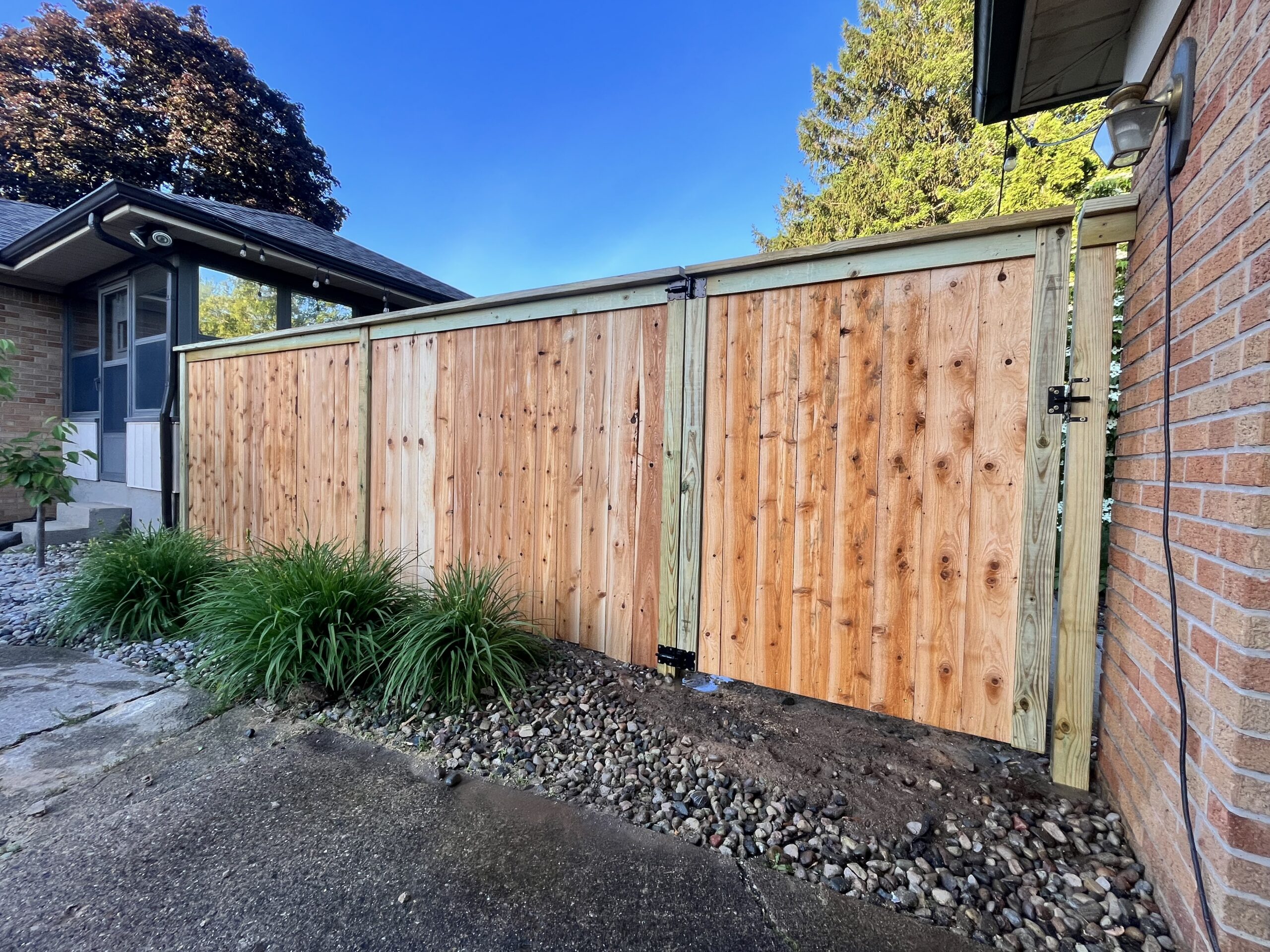
Wood is the most widely installed residential privacy fence material in West Michigan. Cedar and pressure-treated pine are the most common species. Cedar contains natural oils that provide some inherent resistance to moisture and decay, which is a meaningful advantage in Michigan's wet climate. [1] Pressure-treated pine uses preservative treatment to slow decay in ground-contact applications.
The primary threat to wood fence in Michigan is moisture-driven decay, particularly at and just below the ground line where post wood is in sustained contact with wet soil. Properly set posts below the frost line help prevent frost heave, but they do not eliminate the ground-contact moisture exposure that accelerates decay over time. [1] The USDA Forest Products Laboratory research on wood decay mechanisms documents that wood in contact with soil in wet climates requires consistent maintenance to resist fungal decay organisms.
Regular staining, sealing, or painting every 3 to 5 years is the primary defense against moisture damage in wood fence. [1] Failing to maintain the finish allows moisture to penetrate board faces, rails, and post surfaces, accelerating decay. Posts set in concrete that traps moisture at the ground line are particularly vulnerable. Well-maintained wood fence in Michigan typically lasts 15 to 20 years before structural replacement becomes necessary.
Wood repairs are straightforward: individual boards, rails, and posts can be replaced independently without disturbing the rest of the fence, which simplifies storm damage repairs and periodic maintenance replacements. See the wood fence page for style and cost details.
Vinyl Fencing in Michigan
Vinyl fencing does not rot, rust, or absorb moisture, which addresses the primary failure modes that affect wood fence in Michigan's climate. [3] Vinyl panels do not require staining, sealing, or painting. Periodic washing removes dirt, algae, and mildew from the surface, which is the primary maintenance task for vinyl in Michigan.
The main weather-related concern for vinyl in Michigan is thermal behavior. Vinyl has a higher coefficient of thermal expansion than wood or metal. In West Michigan's temperature range, from summer highs to winter lows below zero, vinyl panels expand and contract considerably across the year. [3] Premium-grade vinyl fence systems account for this movement through panel connector design and specified expansion gaps. Economy-grade vinyl installed without adequate expansion room is more prone to panel stress and cracking at connection points over time.
Cold temperature also increases vinyl brittleness. Vinyl becomes less flexible in cold weather, which means impact damage, from a falling branch or a vehicle strike, is more likely to fracture vinyl panels in January than in July. Premium-grade products with thicker profiles are more impact-resistant in cold conditions than thin-wall economy products. [3]
Frost heave affects vinyl the same way it affects wood: post depth is the critical factor, not panel material. Posts must be set below the frost line regardless of fence material. A vinyl fence with properly set posts and premium-grade panels can last 20 to 30 years or more in Michigan conditions. [4] See the vinyl fence page for style and cost details, and the vinyl lifespan guide for a detailed look at longevity factors.
Aluminum Fencing in Michigan
Aluminum does not rust or corrode under normal outdoor conditions, including Michigan's wet climate. [5] This is its primary weather-related advantage. The Aluminum Association notes that aluminum forms a stable oxide layer on its surface that protects the base metal from further oxidation, unlike steel, which continues to corrode once the surface coating is breached.
Aluminum fence is an open ornamental style and does not provide privacy in standard configurations. This limits its use case for homeowners who need visual screening, but makes it well-suited for pool enclosures, front yard boundaries, and decorative garden or property-line applications.
Because the style is open, aluminum fence catches far less wind load than solid wood or vinyl panels. This reduces stress on posts and footings during high-wind events. The mesh-like open structure also sheds snow rather than accumulating it, eliminating the additional structural load that solid privacy fence must carry after heavy snowfall.
Post depth requirements are the same as other materials: posts must be set below the frost line in Michigan. Manufacturer installation specifications for aluminum systems define post dimensions and footing requirements by fence height, and following those specifications is part of warranty compliance. Powder-coat finishes on aluminum may chip or scratch over time. Touch-up with matching finish paint addresses small chips before corrosion develops at exposed metal. See the aluminum fence page for details on styles and residential applications.
Chain Link Fencing in Michigan
Chain link is the most cost-effective perimeter fencing option and performs well structurally in Michigan weather when galvanized or vinyl-coated correctly. Galvanized steel mesh resists rust under most outdoor conditions. Vinyl-coated chain link adds an additional protective layer over the galvanized mesh and provides color options beyond the standard silver-gray.
The primary moisture concern for chain link is at cut ends of the mesh wire and at fittings and connections, where the protective coating may be thinner or absent. Rust at these points is the earliest failure mode for chain link fence in Michigan. [4] Inspecting cut ends and fittings annually and addressing rust spots early extends the fence's service life significantly.
Chain link's open mesh structure means low wind resistance, minimal snow accumulation, and no solid surface to trap moisture or degrade from UV exposure. Posts must still be set below the frost line. Terminal posts (end, gate, and corner posts) carry more load than line posts and require deeper, wider footings.
Chain link provides no visual privacy in standard form. Privacy slats, which thread through the mesh vertically, add partial screening. Slats add cost and require replacement over time as UV exposure and temperature cycling degrade them. See the chain link fence page for cost ranges and application details.
Moisture and Drainage
The single most effective thing a homeowner can do to extend the life of any fence material in Michigan is to manage moisture at the post base. Water that pools around post footings, whether from poor yard drainage, downspout discharge, or low-lying areas, keeps soil and concrete saturated. Saturated soil intensifies frost heave because more water means more ice expansion during freeze cycles. [2]
For wood posts specifically, sustained moisture contact at and below the ground line accelerates fungal decay regardless of how well the above-ground fence surface is maintained. [1] Wood posts in consistently wet soil will decay from the ground line down over a period of years even when the visible fence surface looks intact.
Keeping soil and mulch from building up against fence post bases, ensuring downspouts discharge away from the fence line, and grading the immediate area around posts to direct water away rather than toward the fence are practical steps that apply to every material.
Freeze-Thaw Movement
Frost heave is the dominant installation-related failure mechanism for fence posts in Michigan. All four fence materials discussed here face the same risk: posts set in the frost zone are subject to upward movement each time the soil freezes. Over several winters, marginally shallow posts tilt, lean, and shift the fence out of alignment. [2]
The solution is consistent across materials: set posts below the frost line. In Kent County, the frost depth reaches approximately 42 inches below grade. Most residential fence contractors in West Michigan set posts at 36 to 48 inches, with many using 48 inches as their standard for 6-foot privacy fences.
Post material does not change the frost-heave risk. A vinyl post installed at 30 inches is just as vulnerable as a wood post at the same depth. The panel material above the ground line does not affect what happens to the post below it. See the Fence Post Depth guide for a detailed look at all the factors that affect appropriate post depth in Michigan.
Snow and Ice
Snow accumulation on solid fence panels adds structural load to rails and posts. Six-inch snow depth on a 6-foot solid wood privacy fence running 150 linear feet represents a significant cumulative weight across the fence structure. Well-installed fences handle typical Michigan snowfall without issue. Fences with compromised posts, rotten rails, or loose panel connections are more vulnerable to snow load damage.
Ice storms present a different risk: ice accumulation on branches above the fence adds weight that can cause branches to fall onto the fence structure. This type of impact damage is not unique to any specific material. Any fence material can be damaged by a falling ice-laden branch. Wood is easier to repair after this type of damage because boards can be replaced individually without matching a manufacturer profile or color lot.
Vinyl's cold-temperature brittleness means that impact from falling ice-laden branches is more likely to crack or shatter a vinyl panel than to dent or split wood. Premium-grade vinyl with thicker profiles handles cold-temperature impacts better than economy-grade products. [3]
Wind Exposure
Solid fence panels, both wood and vinyl privacy fence, act as a wind sail during high-wind events. Wind pressure on solid panels transfers force to rails and then to posts and footings. Fences in exposed locations, such as properties on ridge lines, open fields, or locations without significant windbreak from neighboring structures or trees, experience higher wind loads than sheltered suburban properties.
Open-style fence, including aluminum and chain link, allows wind to pass through the structure rather than acting against it. This reduces structural load during windstorms significantly compared to solid panels.
For solid privacy fence in exposed locations, post depth and footing quality are the primary defenses against wind-related failure. Post spacing, rail dimensions, and panel connection method all affect how well a fence distributes wind load. These specifications are part of what varies between a quality installation and a minimum-spec one.
Maintenance by Material in Michigan
Maintenance requirements differ substantially across materials and have a direct effect on long-term cost and fence condition.
Wood. Restaining, resealing, or repainting every 3 to 5 years is required to maintain moisture resistance. [1] An annual inspection to catch early-stage rot at posts and rails, nail or screw corrosion, and loose panels is good practice. Skipping maintenance cycles shortens service life noticeably.
Vinyl. Annual washing with soap and water removes surface contamination that promotes mildew growth. Annual inspection of post plumb, panel connections, and surface condition catches developing issues early. No staining, sealing, or painting required. [3]
Aluminum. Very low routine maintenance. Periodic inspection of the powder-coat finish to catch chips before rust develops at exposed points. Touch up small chips with matching finish paint. No structural maintenance required for sound aluminum panels. [5]
Chain link. Annual inspection of cut ends, fittings, tension wire, and gate hardware for rust. Galvanized mesh that is in good condition requires no regular treatment. Rust at early-stage contact points can be treated before it spreads. [4]
Repairability
How easily a fence can be repaired after damage, from storm impact, frost heave, or normal wear, affects the long-term cost of ownership and the practical experience of maintaining it over time.
Wood is the most repairable material. Individual boards, rails, and posts can be replaced independently. Cedar and pressure-treated lumber are widely available at lumber yards and home improvement stores in West Michigan. A damaged section of wood fence is typically a DIY-capable repair or a straightforward contractor call.
Vinyl is moderately repairable. Individual panels and sections can be replaced if the profile and color are available. Matching becomes harder as a fence ages and manufacturer product lines change. A fence installed 15 years ago may have panels whose profile has been discontinued. [4]
Aluminum is moderately repairable. Panel sections can be replaced using the same manufacturer system. Color and profile matching requires sourcing from the same manufacturer. Bent or dented panels typically require section replacement rather than straightening.
Chain link is highly repairable. Mesh sections can be cut out and replaced with new mesh of the same gauge. Individual fittings, ties, and hardware are standardized. Gate hardware is readily available. Chain link repair is among the most straightforward of any fence material. [4]
Best Material by Homeowner Priority
There is no single best fence material for Michigan weather because homeowners have different priorities. The table below organizes the choice by common homeowner goals.
| Primary Priority | Consider | Why |
|---|---|---|
| Lowest maintenance over time | Vinyl or aluminum | Neither requires periodic staining, sealing, or painting. Annual inspection and occasional washing. [3] [5] |
| Full privacy | Wood or vinyl | Solid panel styles provide complete visual screening. Aluminum and chain link are open styles. [4] |
| Lowest upfront cost | Chain link or wood | Chain link runs $8 to $18 per linear foot installed; wood runs $15 to $34, depending on height and style. |
| Easiest repairs after storm damage | Wood or chain link | Individual components are readily available and replaceable without sourcing manufacturer-specific profiles. [4] |
| No rust risk | Vinyl or aluminum | Neither material contains iron; no rust is possible. Aluminum's corrosion resistance is well documented. [5] |
| Ornamental appearance, pool enclosure | Aluminum | Ornamental style, code-compliant pool gate options, no rust risk. [5] |
| Natural appearance | Wood | Warm, natural look that vinyl and aluminum do not replicate. Cedar and pressure-treated options available. [1] |
For a side-by-side comparison of wood and vinyl specifically, see the Wood vs Vinyl Fence guide. To understand how each material performs over a full service life, see the Which Fence Material Lasts the Longest guide.
Frequently Asked Questions
What fence material holds up best in Michigan winters?
No single material is best for every situation. Vinyl and aluminum resist moisture damage and corrosion that affect wood and can affect galvanized chain link over time. All materials share the same vulnerability at the footing level: posts must be set below the frost line (approximately 42 inches in Kent County) to prevent frost heave. [2] Above that depth, vinyl and aluminum require less annual maintenance than wood. Wood requires regular staining and sealing to resist moisture-driven decay. [1]
Is vinyl fence good for Michigan winters?
Vinyl handles Michigan winters well from a moisture and corrosion standpoint. It does not rot or rust. However, vinyl becomes more brittle in cold temperatures, which makes it more vulnerable to cracking under impact in winter months. [3] Premium-grade vinyl with thicker profiles resists cold-weather brittleness better than economy-grade products. Post depth below the frost line is critical for vinyl as it is for every material.
Does wood fence hold up in Michigan weather?
Wood can perform well in Michigan with proper installation and regular maintenance. Cedar and pressure-treated pine have natural or added resistance to decay, which is the primary weather-related failure mode for wood fence. [1] Wood requires restaining or resealing every 3 to 5 years to maintain that protection. Unmaintained wood fence in Michigan's wet climate deteriorates significantly faster than maintained fence. Post rot at the ground line is the most common failure mode.
Does aluminum fence rust in Michigan?
No. Aluminum does not rust. The Aluminum Association notes that aluminum forms a stable oxide layer that protects the base metal from further oxidation. [5] This makes aluminum a good choice for Michigan properties with high moisture exposure, such as lakeside or low-lying sites. The powder-coat finish on aluminum fence can chip over time; touching up chips prevents any surface corrosion at exposed points.
What about chain link in Michigan winters?
Galvanized or vinyl-coated chain link performs well structurally in Michigan weather. The mesh allows wind and snow to pass through, reducing structural load compared to solid fence. Rust risk is concentrated at cut wire ends and fittings where the coating may be thinner or absent. [4] Annual inspection and early treatment of rust spots extends chain link fence life. Post depth requirements are the same as for any material.
Sources
Sources were selected for relevance, authority, and practical homeowner use. Requirements and recommendations may change, so confirm current local rules before beginning a project.
- USDA Forest Products Laboratory. "Wood Handbook: Wood as an Engineering Material." Government Research. https://www.fpl.fs.usda.gov/documnts/fplgtr/fpl_gtr282.pdf. Accessed August 2026.
- Michigan State University Extension. "Michigan Building and Landscape Resources." University Extension. https://www.canr.msu.edu/. Accessed August 2026.
- CertainTeed. "Bufftech Vinyl Fence — Product Information." Manufacturer Documentation. https://www.certainteed.com/fence/. Accessed August 2026.
- American Fence Association. "Consumer Resources." Trade Association. https://www.americanfenceassociation.com/. Accessed August 2026.
- The Aluminum Association. "Aluminum Applications and Properties." Industry Association. https://www.aluminum.org/. Accessed August 2026.
Related Guides
Materials and Comparisons
Wood vs Vinyl Fence for Michigan Homes
Compare wood and vinyl on appearance, maintenance, cost factors, durability, and Michigan winter performance.
Read Guide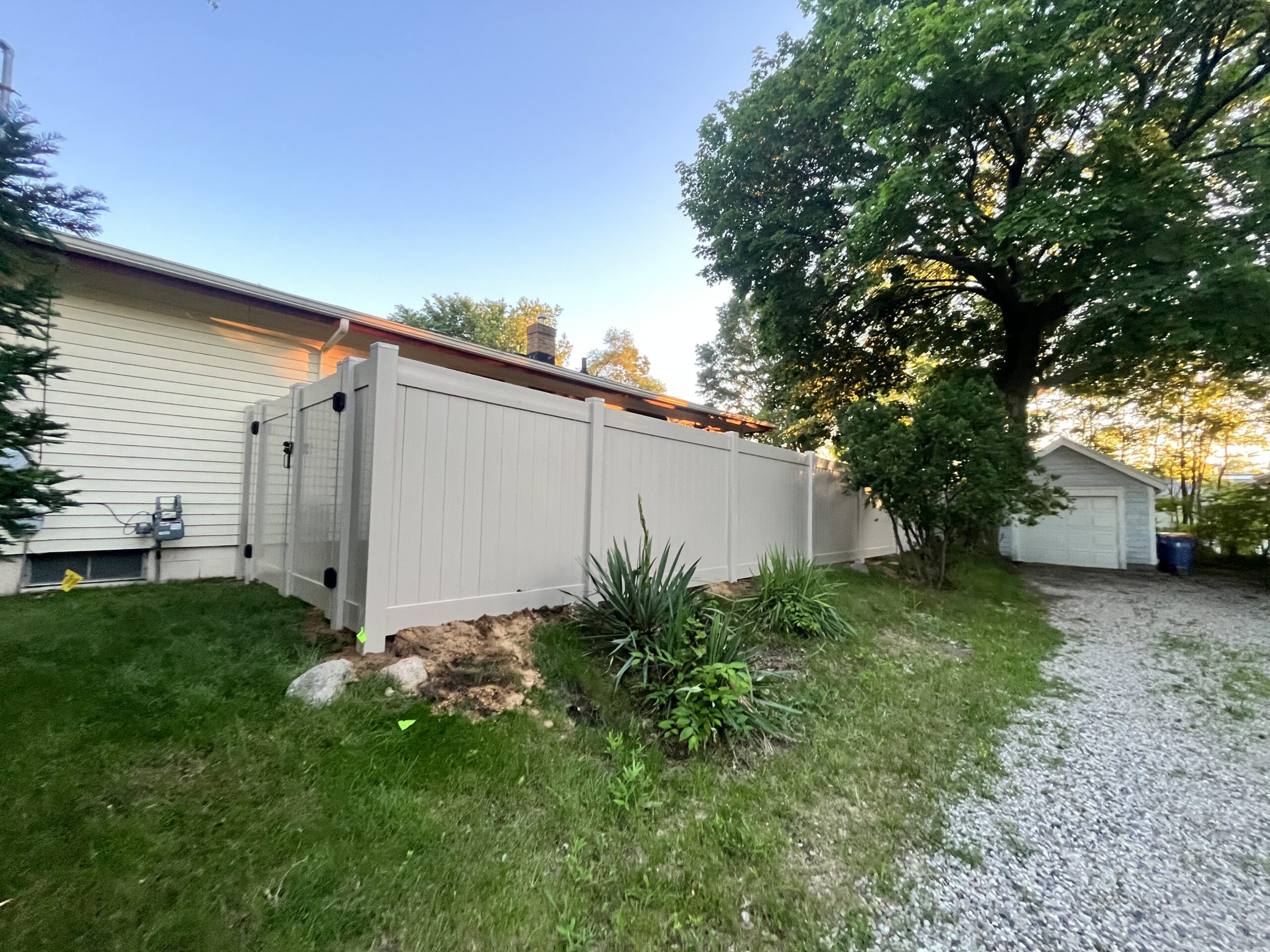
Materials and Comparisons
Which Fence Material Lasts the Longest?
Compare expected service life for wood, vinyl, aluminum, and chain link, with the installation and maintenance factors that affect longevity.
Read Guide
Materials and Comparisons
How Long Does a Vinyl Fence Last?
What affects vinyl fence lifespan, how Michigan weather matters, what warranties actually cover, and when to repair or replace.
Read GuideReady to Plan Your Fence Project?
Compare your options, then request quotes from available fence contractors serving Grand Rapids and West Michigan.